Beginning February 21, 2025, Michigan is under new wage and paid earned sick time laws. We’ve been watching legislative activity around these new laws since August 1, 2024, and we finally have information to share.


NOTE: What is shared here is our current understanding of the laws. Should we become aware of updates or clarifications, we will make updates to this webpage as soon as practical. And, as with any employment issues, if you have specific questions or situations, we strongly encourage you to contact an employment attorney to get clear answers.


The Michigan Department of Labor & Economic Opportunity (LEO) is charged with overseeing implementation of these new laws. LEO offers a robust Frequently Asked Questions page, located here. If you have a specific question that cannot be answered through the FAQs, submit your question to LEO here.


The required posters can be downloaded at no cost here. Remember, at minimum, every employer is required to post BOTH English and Spanish versions of the poster.


UPDATES TO IMPROVED WORKFORCE  
OPPORTUNITY WAGE ACT February 2025


Standard Minimum Wage: 

  • Currently, $10.56/hour; increases to $12.48/hour, February, 21st, 2025. 
  • January 1, 2026: $13.73/hour 
  • January 1, 2027: $15.00/hour 
  • Every January 1st thereafter: Increases along with inflation using the Midwest CPI 


Tip Credit Minimum Wage: 

  • Stays at 38% through 2025 
  • Increases 2% each year thereafter, until it is 50% (in 2031) 
  • Employers MUST ensure employees earn at least minimum wage; fine is $2,500 


UPDATES TO EARNED SICK TIME ACT (ESTA) 


To Whom Does This Apply? 

  • Exempts the following employees: 
  • Employees of the federal government 
  • Unpaid trainees 
  • Unpaid interns 
  • Employees under the Youth Employment Standards Act 
  • Independent contractors (ensure someone is, in fact, an IC)  
  • Employees who meet both conditions: 

1. The employee schedules their own working hours

2.The employer cannot take adverse personnel action against the employee if s/he doesn’t schedule a minimum number of work hours 

  • All employers except the federal government. No exemption for employers of any size. 
  • An employer with 10 or fewer employees (count all employees, regardless of how much they work, seasonal, etc.) is termed “small business” and subject to different guidelines (see below) 
  • All employer’s employees within the state 


How is Sick Time Earned and Used? 

  • One hour of earned sick time for every 30 hours worked 
  • Small businesses are not required to provide more than 40 hours paid sick leave annually, unless the employer selects a higher limit 
  • Other businesses are not required to provide more than 72 hours paid sick leave annually, unless the employer selects a higher limit 
  • Can be used increments of one hour or smallest increment that other forms of time off are offered in 
  • Carryover of earned sick time is capped at 72 hours. Use it or lose it. 
  • Accrual of paid earned sick time begins on February 21, 2025 or the employee’s start date, whichever is later 
  • Employers may require employees to wait until 120 calendar days after their start date to utilize paid earned sick time 
  • Specifically for part-time (PT) employees: (essentially, track their time, and "true up" if they actually earn more than originally planned)
    • As an alternative to accrual of paid earned sick time, the employer may provide paid earned sick time at the beginning of the year for immediate use in accordance with: 

1. The employer provides the PT employee with written notice of how many hours s/he is expected to work for a year at the time of hire 

2. The amount of earned sick time provided to the employee at the beginning of the year is, at minimum, proportional to the time the employee would accrue if the employee worked all of the hours expected as outlined in said written notice 

3. If the employee works more than outlined in said written notice, they must be provided with the additional sick time in accordance with the “one hour for every 30 worked” expectation 


For What Purpose Can Employees Use Their Paid Earned Sick Time? 

  • Personal or family health needs (very broadly defined)  
  • Domestic violence and sexual assault    
  • Child’s health or disability    
  • Public health emergencies   


Can I Frontload Paid Earned Sick Time? 

  • All employers may offer, as an alternative to the accrual of paid earned sick time, not less than 40 hours (small businesses) or 72 hours (other businesses) a “frontloaded” bank of time at the beginning of the year. If an employer chooses this option, they are not required to: 
    • Allow employees to carry over any unused earned sick time, year to year  
    • Calculate and track employees’ accrual of paid earned sick time 
    • Pay employees the value of unutilized paid earned sick time at the end of the year in which it was earned 
    • We are awaiting direction from Michigan’s Labor & Economic Opportunity (LEO) Department on whether you can prorate the hours (40/72) for 2025. 


Notification by Employee: 

  • Employee provides seven days advance notice for foreseeable absences 
  • If not foreseeable, the employee must either give notice as soon as practicable OR in accordance with employer’s policies 


Can I Require Documentation? 

  • Employers can require this if the absence was three or more consecutive days; employee can take up to 15 days to provide documentation 
  • While waiting for documentation, you must provide employee the benefit of the doubt 


Increments of Time Employees Can Use: 

  • Either one-hour increments, OR the smallest increment the employer uses to account for absences 


Can I Take Disciplinary Action? What’s My Liability and Potential Penalties? 

  • Employers may take disciplinary action for employees’ failure to notify or misuse of the benefit 
  • The “rebuttable presumption” of violation is removed 
  • Private right of action is also removed 
  • Employer’s fine for violation is 8x the employee’s normal hourly wage for the entire timeframe during which the violation is said to have occurred (i.e., employee was denied utilization of 16 hours paid earned sick leave = 8x16xhourly wage) 
  • Employees have three years to file a complaint with the MI LEO Department 


How Long do I have to Prepare and Roll-Out Our New Policies? 

  • Employers have 30 days(March 23rd) to provide written notice to all employees of their new policies and post new posters and must provide new hires with this information as soon as they begin employment. If the employer changes the notification procedures, employees must be notified of this within five days of the change. 
  •  As of Feb 21st, LEO has asked for time and patience to generate posters and FAQs. However, you can already download the English version poster here
  • SMALL BUSINESSES have until October 1, 2025 to comply 
  • NEW BUSINESSES have a three-year grace period to comply (three years from the date of hiring their first employee) 
  • FOR ALL OTHERS, this new Act is in effective immediately 


Do I Have to Pay Out for Unused Paid Earned Sick Time When the Employee Leaves? 

  • No. However, if your official employee policies imply that you will pay out for any unused benefits, you might be on the hook. You can update your policy to explicitly exclude unused paid earned sick time from being paid out at end of employment. 


Recordkeeping: 

  • Employers still must track hours worked and paid sick time used 
  • Employers must keep the records for three years 


Learning What Matters

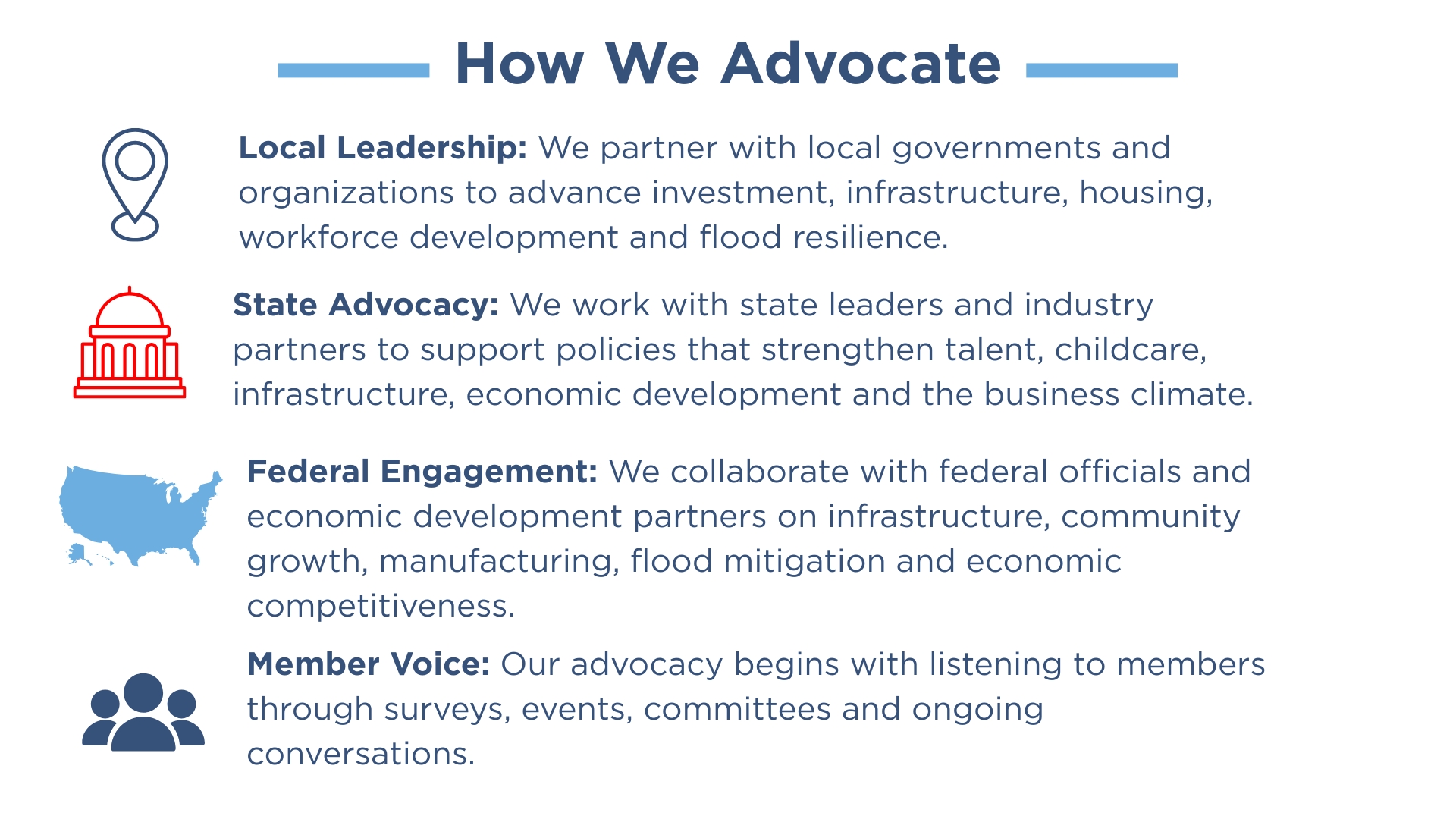
Being the voice for Midland’s business community means the Midland Business Alliance (MBA) advocates for strategic business issues that advance pro-business platforms at the local and state level. By harnessing the power of our more than 3,000 businesses, our collective voice is stronger than any of us on our own. The MBA will regularly take the pulse of both our businesses and the community at large to see what public policy issues and priorities matter the most — and then act on them. Once these high-priority topics have been identified, we will convene the necessary groups and resources to influence them. Depending on the issue, this could include working with local and state elected officials, related advocacy groups, as well as regional partners and organizations.

Issues & Answers

The MBA offers quarterly Issues & Answers programming. Issues & Answers are luncheons that provide a deep dive into a timely public policy topic where you can ask the expert and learn how the issue impacts your business and how we are advocating on your behalf. 
 

Issues & Answers

The MBA selects legislative priorities for each year and we use them as a roadmap to navigate the current landscape in Midland, Lansing, and D.C. to best advocate for our business community. Find our 2025/2026 Legislative Priorities below.

Want to learn more about our 2025–2026 Legislative Priorities?
Click the link below to explore how we’re advocating for policies that support business growth, talent development, and infrastructure in Midland County.

Legislative Priorities